About me:
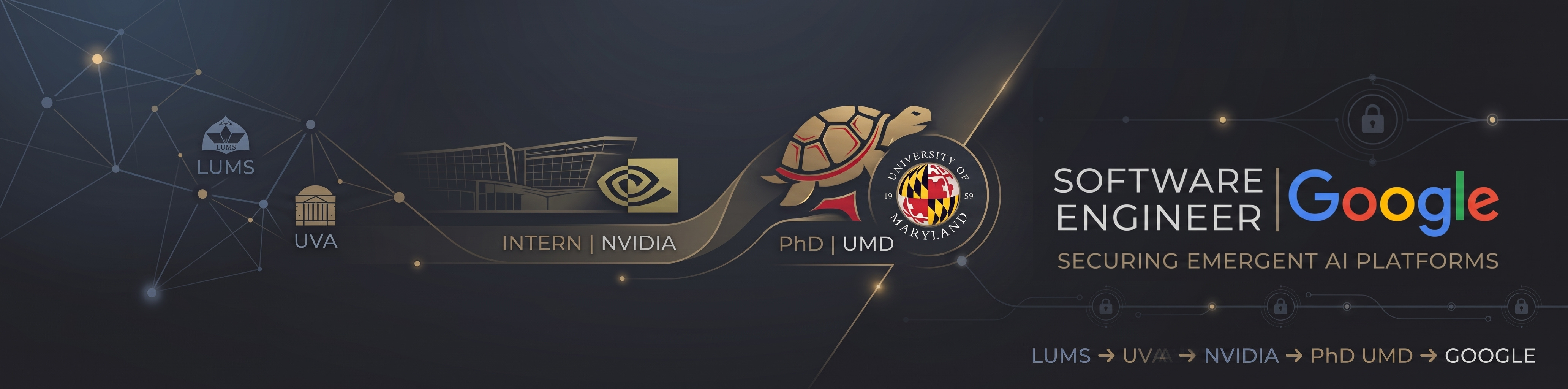
Hello! I am Ali Ahad, a Software Engineer at Google, working on Security for Emergent AI Platforms. I completed my Ph.D. in Electrical and Computer Engineering at the University of Maryland, advised by Professor Yonghwi Kwon. Over the course of my doctoral and industry research — including work at NVIDIA — I designed LLM-driven binary analysis tools, partition-based isolation frameworks, and platform attestation architectures to harden large-scale systems.
Research interests. My core focus areas are Security for Emergent AI Platforms, Program Analysis & Reverse Engineering, Systems & Software Security, and Decompilation & Binary Hardening.
News:
- Aug ‘26: Joined Google as a Software Engineer, working on Security for Emergent AI Platforms 👨🏽💼
- Apr ‘26: Successfully Defended — Dr. Ali Ahad! Ph.D. ✅🎓
- Jan ‘25: Passed my Ph.D. Proposal. Now a Ph.D. Candidate! ✅⏳
- May ‘24: Joined NVIDIA as “System Software Intern, Data Center System Security” for Summer’24 👨🏽💼
- Jan ‘24: Joined UMD to continue my Ph.D. with my lab! 🏃♂️➡️📚
- Sep ‘23: Joined NVIDIA as “Software Intern, Security” for Fall’23 👨🏽💼
- Jul ‘23: Completed my MS at UVA! 🎓
- May ‘23: Passed my Ph.D. Qualifying Exam! ✅⏳
- Apr ‘23: “FreePart: Hardening Data Processing Software via Framework-based Partitioning and Isolation” accepted in ASPLOS’24 🥳
- Nov ‘22: “PyFET: Forensically Equivalent Transformation for Python Binary Decompilation” accepted in S&P’23 🥳
- Nov ‘21: “SwarmFlawFinder: Discovering and Exploiting Logic Flaws of Swarm Algorithms” accepted in S&P’22 🥳
- Sep ‘21: “Forensic Analysis of Configuration-based Attacks” accepted in NDSS’22 🥳
- May ‘21: “Swarmbug: Debugging Configuration Bugs in Swarm Robotics” accepted in FSE’21 🥳
- Mar ‘21: “Spinner: Automated Dynamic Command Subsystem Perturbation” accepted in CCS’21 🥳
- Aug ‘20: Joined UVA to start my Ph.D. in CS! 📚
Publications:
“FreePart: Hardening Data Processing Software via Framework-based Partitioning and Isolation”: Ali Ahad, Gang Wang, Chung Hwan Kim, Suman Jana, Zhiqiang Lin, and Yonghwi Kwon, In Proc. of the 29th International Conference on Architectural Support for Programming Languages and Operating Systems (ASPLOS ‘24)
“PyFET: Forensically Equivalent Transformation for Python Binary Decompilation”: Ali Ahad, Chijung Jung, Ammar Askar, Doowon Kim, Taesoo Kim, and Yonghwi Kwon, In Proc. of the 44th IEEE Symposium on Security and Privacy (S&P ‘23)
“SwarmFlawFinder: Discovering and Exploiting Logic Flaws of Swarm Algorithms”: Chijung Jung, Ali Ahad, Yuseok Jeon, and Yonghwi Kwon, In Proc. of the 43rd IEEE Symposium on Security and Privacy (S&P ‘22)
“Forensic Analysis of Configuration-based Attacks”: Muhammad Adil Inam, Wajih Ul Hassan, Ali Ahad, Adam Bates, Rashid Tahir, Tianyin Xu, and Fareed Zaffar, In Proc. of the 29th Network and Distributed System Security Symposium (NDSS ‘22)
“Swarmbug: Debugging Configuration Bugs in Swarm Robotics”: Chijung Jung, Ali Ahad, Jinho Jung, Sebastian Elbaum, and Yonghwi Kwon, In Proc. of 29th ACM SIGSOFT International Symposium on the Foundations of Software Engineering (FSE ‘21)
“Spinner: Automated Dynamic Command Subsystem Perturbation”: Meng Wang, Chijung Jung, Ali Ahad, and Yonghwi Kwon, In Proc. of 28th ACM Conference on Computer and Communications Security (CCS ‘21)